.png)
PropTech
The Next Phase of Proptech: From Integration to Experience
With Spaceflow’s full integration into Hydda, we are seeing the blueprint for the next decade. Here is how we see the proptech ecosystem evolving toward 2030.
Let’s look at how we approach integration capability, how it benefits our clients, and where the proptech landscape is heading in the near future.
The weakest link in real estate operations is the complex, often outdated grouping of technology and processes considered “standard practice” across the industry. For owners and operators looking to embrace digital transformation, that fragmented landscape can only be solved by more proptech providers adding or upgrading their own integration capability.
At Spaceflow, we see integrations as the backbone of the modern building ecosystem. They are how we push the industry toward the effective collaboration and cohesion clients need to succeed. Let’s look at how we approach integration capability, how it benefits our clients, and where the proptech landscape is heading in the near future.
From the very beginning, we recognized that Spaceflow needed to be a software platform that could connect with smart tools, devices, and other Software-as-a-Service (SaaS) systems to deliver a truly 360° solution for our clients.
That strategy was based on our vision for Spaceflow, a platform to connect the entire building ecosystem—people, spaces, and data—through a single, user-friendly experience. Integrations built on our native UI and our open API are how we make that vision come to life.
We build our native user interface (UI) directly on top of integrations, meaning the end-user (tenant) gets a cohesive experience no matter what feature they’re using. The user experience feels smooth and natural, rather than requiring a different app or interface for every single use case.
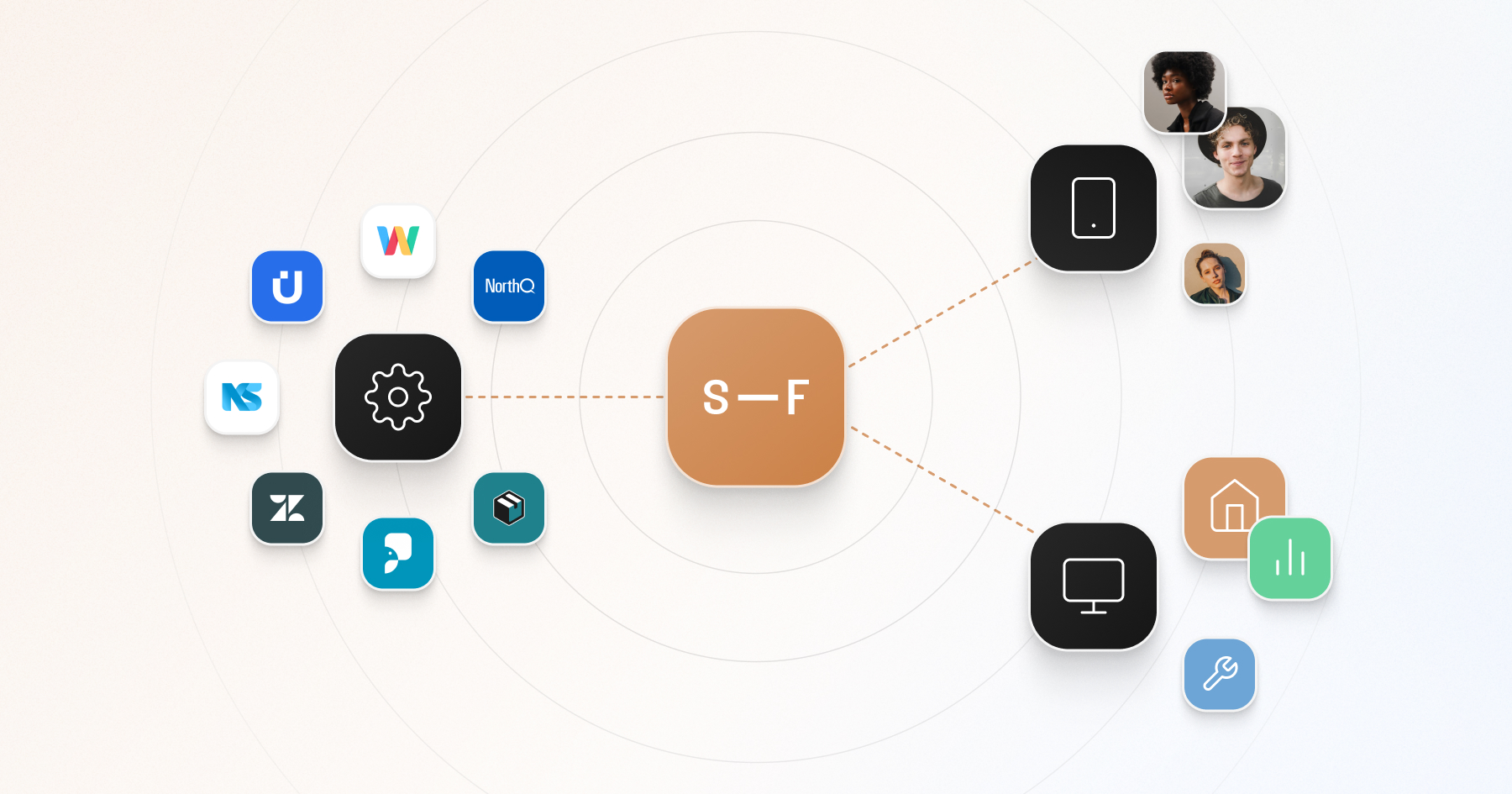
Including integrations in our product strategy from day one made the decision to introduce an open API around 2022 a natural evolution. It gave clients the flexibility to link their preferred tools and data sources without requiring heavy custom development, making Spaceflow the connective layer between systems.
This decision has paid off significantly:
One client used the open API to connect their digital signage (via ZetaDisplay) to Spaceflow to show Newsfeed posts and events in the building lobby. This contributed to app adoption and tenant engagement.
Others have integrated their preferred property management system to simplify and streamline tenant management for the property managers.
In short, opening our API helped us scale and reposition Spaceflow as a platform, not just an app.
It’s true that while providing an open platform is vital, maintaining reliability across multiple external systems is complex.
We actively advise clients—especially during onboarding or digital transformation planning—and help them think strategically about building a truly connected tech stack, rather than just randomly linking tools ad hoc.
We generally recommend that clients start with integrations that have the highest operational or tenant impact—such as access control, ticketing, and tenant management. We also share best practices around data flow, ensuring there is a single source of truth for all user and lease data.
The nature of the integration focus changes based on the client’s situation:
Either way, our open API ensures flexibility and guarantees that clients can evolve their tech stack without being locked into a single provider.
Many tech providers limit their clients and partners to isolated, one-off integrations, but that approach stifles innovation and scalability and leaves clients locked into rigid solutions.
Large enterprise systems, such as traditional ERP-based real estate management platforms, often rely on proprietary integration methods and centralized control. While robust, this approach can limit clients to predefined integration patterns and slow down innovation compared to open, event-driven platforms.
There are two main ways we decide who to integrate with:
Client-driven integrations: These integrations come from the client’s current ecosystem. We focus on connections that allow Spaceflow to fit seamlessly into the essential tools clients already use, such as access control, ticketing, or property management solutions. This strategy ensures minimal friction and provides immediate value upon implementation.
When our build-to-rent client required an integration with Arthur, their chosen tool for ticketing and maintenance requests, we integrated early in the process so the connection was live starting from day one of launching their resident app.
Strategic integration partners: These partnerships are designed to help drive sales or bolster strategic differentiation. We choose partners that align with our long-term product vision and strengthen Spaceflow’s position as a market leader.
One example of that is our partnership with Utopi. They share our vision of elevating the tenant experience, engaging tenants in sustainability, and making operations cost-effective. The integration brings brand new functionality and measurable value for both operators and tenants.
For real estate companies facing the complexity of migrating or updating their tech stack, our guiding principle for any integration is simple: it must enhance the user experience, save client operations time, and deliver measurable value.
To deliver on our promise of a seamless, connected ecosystem, we rely on robust and modern technical standards:
The future of proptech lies in collaboration and open platforms. Those who refuse to integrate and open their APIs are operating at a massive disadvantage. We’re committed to leading this change, ensuring that Spaceflow acts as the central hub—connecting mobile, admin, and partner systems for a superior tenant experience and streamlined property operations.

Join our mailing list
.jpg)